Without the central influence of the Valyrian empire, the speech of their descendants and former colonies mutated into vernacular speech known as “Low Valyrian”, or “Bastard Valyrian”. Low Valyrian is not one language, so much as a family of diverse dialects well on their way to becoming separate languages – so much so that even those who speak one might not be able to speak another, and without mutual intelligibility, it could be argued that they have truly become separate languages.
Each of the Nine Free Cities has its own dialect/language of Low Valyrian. These include Braavosi, Lorathi, Lysene, Myrish, Norvoshi, Pentoshi, Qohorik, Tyroshi, and Volantene. Slaver’s Bay also has its own dialect/language of Low Valyrian, making for a total of ten different branches.
Low Valyrian is basically organized into three branches: Northern, Southern, and Ghiscari (which might be termed “Eastern”). There is a linguistic divide between the northern and southern Free Cities: the dividing line is roughly the latitude formed by the no-man’s land around the Sorrows and Dagger Lake – thus Myr is in the southern group and Pentos is in the northern group. Volantis long dominated the other southern Free Cities, so the four Southern dialects are all fairly similar.
Vulgar Latin or Sermo Vulgaris (“common speech”) was the nonstandard form(s) of Latin (as opposed to classical or refined or ‘proper’ literary version of the language) spoken in the Mediterranean region during and after the classical period of the Roman Empire. It is from Vulgar Latin that the Romance languages developed; the best known are the national languages Italian, Spanish, Portuguese, Romanian, and French. Works written in Latin during classical times and the earlier Middle Ages used Classical Latin rather than Vulgar Latin, with very few exceptions (most notably sections of Gaius Petronius’ Satyricon). Because of its nonstandard nature, Vulgar Latin had no official orthography. Vulgar Latin is sometimes also called colloquial Latin,[1] or Common Romance (particularly in the late stage). In Renaissance Latin, Vulgar Latin was called vulgare Latinum or Latinum vulgare.[citation needed]
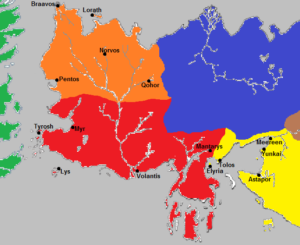
Map of the dialects of High Valyrian
By its nature Vulgar Latin varied greatly by region and by time period. A few major divisions can be seen, however. Vulgar Latin dialects began to significantly diverge from Classical Latin during the 3rd century during the classical period of the Roman Empire. Nevertheless up to the 4th and 5th centuries AD, the most widely spoken dialects were still similar to and mostly mutually intelligible with Classical Latin. With the collapse of the Western Roman Empire in the 5th century, the Gothic and Frankish rulers of western Europe created a substantially different Germanic-influenced language, a language that was substantially different from Classical Latin; indeed it is this one that is most often known as Proto-Romance. Similarly in the Eastern Roman Empire as Latin faded as the court language, the Vulgar Latin spoken there became heavily influenced by Greek and Slavic and also became radically different from Classical Latin and from the proto-Romance of Western Europe.