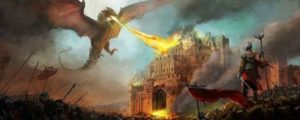
Wildlings South of the Wall: How shifting attitudes of the Wall in Game of Thrones mirror contemporary interpretations of the Hadrian’s Wall system.

Conventional interpretations of Hadrian’s wall modelled the structure as a hard line of defense that separated the “civilised Romans” from the “barbarous” native Britons. The wall was believed to be not only a delineation of Roman territory but a physical barrier to protect the Romans from the violent and uncouth barbarians. As excavation in the region has continued, the modern interpretation of the wall has shifted away from such a hardline stance and instead has progressed to encompass a wide variety of functions. In modern scholarship, Hadrian’s wall is more porous – it is a frontier where cultural exchange, trade, defense, and domestic life intersect in complicated and unique ways. While the presence of the Roman army in the area suggests a certain threat, it is softened by certain structural features of the wall.

This shift in the scholarship is beautifully reflected in HBO’s Game of Thrones. When we are first introduced to The Wall, modelled after Hadrian’s wall, it is at first a massive structure that separates civilization from Wildings, crude, barbarous people who live in the frigid North. This is seen in especially in season one when Jon, and the viewer is introduced to the Night’s Watch. In later seasons, symbolised by Jon’s romance with Ygritte and his eventual, yet controversial decision to let the Wildlings through in Season 5, these tensions are mitigated and the wall becomes a security checkpoint rather than a defensive structure, at least with respect to the Wildlings. This diachronic progression is an excellent example of how popular culture can both influence, and be inspired by our interpretations of classical archaeological finds. Fantasy is a genre to explore possibilities often not considered in our world, something that perhaps could help us think outside of the box when understanding the Romans and their intentions.


Low Valyrian – Experimentation into the development of Vulgar Latin

Without the central influence of the Valyrian empire, the speech of their descendants and former colonies mutated into vernacular speech known as “Low Valyrian”, or “Bastard Valyrian”. Low Valyrian is not one language, so much as a family of diverse dialects well on their way to becoming separate languages – so much so that even those who speak one might not be able to speak another, and without mutual intelligibility, it could be argued that they have truly become separate languages.

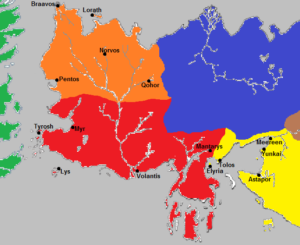
Each of the Nine Free Cities has its own dialect/language of Low Valyrian. These include Braavosi, Lorathi, Lysene, Myrish, Norvoshi, Pentoshi, Qohorik, Tyroshi, and Volantene. Slaver’s Bay also has its own dialect/language of Low Valyrian, making for a total of ten different branches.

Low Valyrian is basically organized into three branches: Northern, Southern, and Ghiscari (which might be termed “Eastern”). There is a linguistic divide between the northern and southern Free Cities: the dividing line is roughly the latitude formed by the no-man’s land around the Sorrows and Dagger Lake – thus Myr is in the southern group and Pentos is in the northern group. Volantis long dominated the other southern Free Cities, so the four Southern dialects are all fairly similar.

Vulgar Latin or Sermo Vulgaris (“common speech”) was the nonstandard form(s) of Latin (as opposed to classical or refined or ‘proper’ literary version of the language) spoken in the Mediterranean region during and after the classical period of the Roman Empire. It is from Vulgar Latin that the Romance languages developed; the best known are the national languages Italian, Spanish, Portuguese, Romanian, and French. Works written in Latin during classical times and the earlier Middle Ages used Classical Latin rather than Vulgar Latin, with very few exceptions (most notably sections of Gaius Petronius’ Satyricon). Because of its nonstandard nature, Vulgar Latin had no official orthography. Vulgar Latin is sometimes also called colloquial Latin,[1] or Common Romance (particularly in the late stage). In Renaissance Latin, Vulgar Latin was called vulgare Latinum or Latinum vulgare.[citation needed]

Map of the dialects of High Valyrian

By its nature Vulgar Latin varied greatly by region and by time period. A few major divisions can be seen, however. Vulgar Latin dialects began to significantly diverge from Classical Latin during the 3rd century during the classical period of the Roman Empire. Nevertheless up to the 4th and 5th centuries AD, the most widely spoken dialects were still similar to and mostly mutually intelligible with Classical Latin. With the collapse of the Western Roman Empire in the 5th century, the Gothic and Frankish rulers of western Europe created a substantially different Germanic-influenced language, a language that was substantially different from Classical Latin; indeed it is this one that is most often known as Proto-Romance. Similarly in the Eastern Roman Empire as Latin faded as the court language, the Vulgar Latin spoken there became heavily influenced by Greek and Slavic and also became radically different from Classical Latin and from the proto-Romance of Western Europe.

The Golden Crown: Torture Practices in the Ancient World

Khal Drogo – Leader of the Dothraki and perpetrator of the Golden Crown execution

In S01E06 “A Golden Crown,” Viserys Targaryen, claimant to the Iron Throne of Westeros, is frustrated and tired of waiting amongst the Dothraki savages who are supposed to lend military aid to his bid for power. Having married his sister Daenerys off to the Dothraki leader, Khal Drogo, Viserys demands that the latter fulfils his promise of helping him to obtain the crown. In the process, he threatens to take Daenerys away and to kill her and Drogo’s unborn child. As if that were not bad enough, he breaks the taboo against drawing a blade in Vaes Dothrak, the Dothraki’s sacred city. His actions earn him a very different golden crown than he had bargained for.

It might seem like such a brutal and potentially wasteful manner of execution would be confined to the pages of A Song of Ice and Fire, but there are several examples from history that demonstrate that this is not the case. Indeed, history or at least the recording of that history took it to the next level. While Drogo ‘crowns’ the offending Viserys by pouring molten gold over his head, several historical examples see molten metals forced down the throat of the victim in a symbolic repaying of his greed or as a purifying agent of judgement.

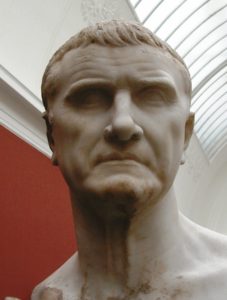
Bust of Crassus

Given that theme of pecuniary avarice, there can be no better place to start than with the most (in)famous individual from ancient history to have seemingly suffered such a fate: the rapacious plutocrat, Marcus Licinius Crassus. Having bought up much of Rome and used his tax contracts to strip the province of Asia of its wealth, Crassus decided to try winning a military reputation similar to those of his allies in the First Triumvirate, Pompeius Magnus and Julius Caesar.

An Essos Carthage? How the Villainization of the Ghiscari Empire was inspired by Carthage

Nullam et nulla non massa vulputate consectetur nec nec nulla. Integer tellus lorem, tincidunt a orci sed, feugiat pulvinar justo. Phasellus pellentesque nibh scelerisque, rutrum magna a, suscipit orci. Nullam luctus molestie velit. Pellentesque sed vehicula massa. Nulla faucibus eleifend purus in ultricies. Duis elementum laoreet laoreet. Nullam feugiat eu eros quis porta. Vivamus justo nulla, fermentum vel auctor quis, mollis vel ipsum. Cras id lacus mattis, bibendum nibh vitae, dapibus velit. Morbi tempor dapibus ipsum, ut laoreet enim mattis non. Duis ut lacus eget nibh vulputate pellentesque ac nec odio. In tempor justo eget erat accumsan, sed ullamcorper massa imperdiet. Vivamus id turpis sapien.

Phasellus accumsan vestibulum felis, ac egestas tortor elementum at. Vestibulum suscipit fringilla sapien facilisis tempor. Aenean feugiat arcu turpis, in dictum nulla varius at. Phasellus velit diam, placerat a varius id, pharetra in dolor. Fusce eu est ut tellus efficitur gravida et vel nunc. Etiam vulputate lectus in dui imperdiet tempus ut eu risus. Praesent bibendum pulvinar leo, sit amet dignissim massa tincidunt sit amet. Nam non consequat velit. Vestibulum id ipsum ac leo congue suscipit eu ac sem. Class aptent taciti sociosqu ad litora torquent per conubia nostra, per inceptos himenaeos. Vestibulum libero nisl, tincidunt vitae urna efficitur, aliquet luctus nulla. Donec finibus fringilla sem in mattis. Nunc congue elit augue, at dictum felis facilisis eget. Etiam lacinia arcu lectus, sit amet aliquam augue feugiat at.

Sed quis maximus elit. Nullam auctor rhoncus pellentesque. Integer maximus tellus at nisi suscipit, a vestibulum leo convallis. Duis blandit sit amet odio vitae malesuada. In erat augue, molestie quis lorem ac, faucibus elementum neque. Quisque facilisis justo vitae iaculis finibus. Maecenas nec nulla a augue lobortis pretium. Sed bibendum laoreet nulla. Etiam euismod magna ante, a lobortis sem rutrum id. Donec faucibus turpis a risus feugiat ultricies.